When does Newton Newton?
The struggle of naming reference frames
2026-09-20 · 6 min · #physics
Physicists are bad at naming things. They are almost as bad at this as computer scientists. Nowhere is this more clear than in the case of reference frames in which Newton's laws are obeyed.
In this case, not only did physicists give this concept a subpar name, they have proceeded to give it many other names to muddy the waters even further.
What is a Reference Frame?
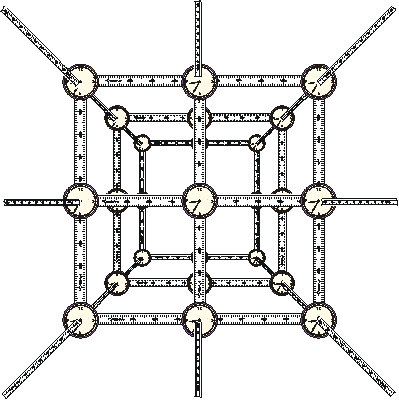
A reference frame is a system of clocks and rulers that lets you measure the motion of objects.1 You are in a particular reference frame at a certain velocity. Observers who are moving at different speeds are in different reference frames because they measure different values for distances between events in both space and time.
This is especially relevant in relativity, where observers in different reference frames don't only measure different velocities, but also different amounts of time passing between events.
What is an inertial reference frame?
An inertial reference frame is a frame in which Newton's law's apply. The simplest way to determine whether you are in such a frame is to throw a ball (or insert a test particle) and see if:
- The ball stays in motion unless acted on by an outside force.
- The ball accelerates proportionally to the force on it.
You can also feel if you're in an inertial reference frame. Your gut will let you know if you are experiencing proper acceleration.2
But "inertial reference frame" isn't the only thing this is called. There are countless other names for it that I'm about to compare. These are names for the frame I've heard from class, encyclopedia, professors, and textbooks.
Names
Inertial
Newton's first law of motion is the law of inertia. If you are in an inertial reference frame, the ball (or test particle) will stay in motion.
I understand using "inertial" in the name. It refers to a law of motion that objects follow in this reference frame. But objects in inertial reference frames also obey Newton's second law. And since the first law is qualitative, it's easier to test whether an object is following the second law than the first.
But, from my understanding, objects that disobey the second law also disobey the first. So the focus on inertia is acceptable.
One confusion people may have is to consider the frame to "have inertia". This might lead to misunderstanding how the frames work. Or, perhaps, it is better to teach why the term "inertia" was initially chosen.
This appears to be the most commonly used term. My classical mechanics class and textbook used it.
Inertial Space
From what I can tell, "inertial space" describes the same concept as an inertial reference frame, but with an emphasis on the geometric space. For example, it appears to be used in astronomy. However, I can't find many uses of it beyond Wikipedia saying it's a synonym for inertial reference frame and a few textbook references.
I think this just adds more confusion. Yes, change the word from "frame" to "space". Surely that will clarify things!
Galilean
A Galilean reference frame refers to Galilean relativity. This is like Einstein's relativity but without time, so it's incomplete. Otherwise it's the same concept: objects moving with different velocities measure different values for the positions of objects at different times. They're called "Galilean" in this case because they are connected by Galilean transformations.
I encountered this when looking up information about reference frames for my relativity class.
Free-Float
You experience an inertial reference frame when you are in free-float. This means you are experiencing no forces other than the "force" of gravity. In relativity, gravity is no longer considered a force, so you are experiencing no force and thus no proper acceleration. Thus a "free-float" frame is the same as an inertial reference frame.
Gravity not a force in relativity because it is caused by the curvature of spacetime. Masses naturally get closer because spacetime itself is warped. When you fall, no force acts on you. There is zero net force. However, when you stand, the floor pushes back on you, creating an upward net force (time slows for you when you jump because of this).
This term is useful for explaining the concept, but is yet another term for the same thing. I encountered this in my relativity class.
Free-Fall
This is the same concept as a free-float frame, but with an emphasis on falling. This is what Einstein was referring to when he said that the "happiest thought of [his] life" was imagining a person falling from a roof. Otherwise everything about gravity and time is the same.
Lorentz
Lorentz reference frames refer to using Lorentz transfromations to convert spacetime coordinates between frames in special relativity. This is similar to Galilean reference frames but adds the cosmic speed limit.
Because this simply refers to different frames connected through Lorentz Transformations, I don't think it needs a special name.
Lawful
This refers to a reference frame which follow's Newton's laws. But "lawful" is unclear. Which laws does such a frame follow? Once it's understood that it's Newtonian laws that are followed, this is straightforward. The term quickly reminds the reader that we are thinking about the fact that objects in these frames obey certain laws.
However, other parts of relativity, such as the requirement that the speed of light is constant across reference frames, is dependent on the fact that some laws of physics are the same in all reference frames—specifically Maxwell's equations, which independently derive the speed of light.
This was the preferred term in my relativity class, replacing the others.
Newtonian
The only sensible renaming of an "inertial" reference frame I might consider is "Newtonian". This is because such reference frames follow Newton's laws. It takes the best from "inertial" and "lawful" to be more specific overall. I do not believe this justifies using yet another term.
Conclusion
In my opinion, we should stick with inertial reference frame. It's the simplest one and refers to one of the laws that must be followed. It does require learning what "inertial" means in this context, but this is far better than embracing the plethora of terms breed confusion.
Let me know if you have any other names for these reference frames, or have thoughts on other physics naming absurdities!
-
The clocks and rods image is from The Special Theory of Relativity. Copyright © 1999 David M. Harrison. Licenced under CC BY-NC-SA 2.0. ↩
-
I presented on this a few months ago and have a draft of this on my blog in progress. Let me know if you're interested in seeing it and I might be motivated to complete it sooner! ↩